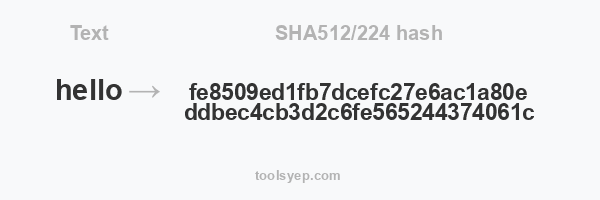
This online tool allows you to generate the hash sha512/224 of any string.
SHA512/224 length is 56 characters
Hash available
MD2 Hash, MD4 Hash, MD5 Hash, SHA1 Hash, SHA224 Hash, SHA256 Hash, SHA384 Hash, SHA512/224 Hash, SHA512/256 Hash, SHA512 Hash, SHA3-224 Hash, SHA3-256 Hash, SHA3-384 Hash, SHA3-512 Hash, RIPEMD128 Hash, RIPEMD160 Hash, RIPEMD256 Hash, RIPEMD320 Hash, WHIRLPOOL Hash, TIGER128,3 Hash, TIGER160,3 Hash, TIGER192,3 Hash, TIGER128,4 Hash, TIGER160,4 Hash, TIGER192,4 Hash, SNEFRU Hash, SNEFRU256 Hash, GOST Hash, GOST-CRYPTO Hash, ADLER32 Hash, CRC32 Hash, CRC32B Hash, CRC32C Hash, FNV132 Hash, FNV1A32 Hash, FNV164 Hash, FNV1A64 Hash, JOAAT Hash, MURMUR3A Hash, MURMUR3C Hash, MURMUR3F Hash, XXH32 Hash, XXH64 Hash, XXH3 Hash, XXH128 Hash, HAVAL128,3 Hash, HAVAL160,3 Hash, HAVAL192,3 Hash, HAVAL224,3 Hash, HAVAL256,3 Hash, HAVAL128,4 Hash, HAVAL160,4 Hash, HAVAL192,4 Hash, HAVAL224,4 Hash, HAVAL256,4 Hash, HAVAL128,5 Hash, HAVAL160,5 Hash, HAVAL192,5 Hash, HAVAL224,5 Hash, HAVAL256,5 Hash,
What is SHA-512/224?
SHA-512/224 is a cryptographic hash function belonging to the SHA-2 family. While the name might seem confusing, it is essentially the SHA-512 algorithm with two modifications: different initial hash values and a truncated 224-bit output. It was introduced to provide a high-security hash that is specifically optimized for 64-bit architectures, offering the security profile of the SHA-2 family but with performance benefits that the 32-bit SHA-224 cannot match.
How does SHA-512/224 hash work?
The algorithm follows the core logic of SHA-512 but adapts the initialization and final stages:
- Initialization: It uses unique initial hash values (distinct from both SHA-224 and SHA-512) to ensure that the output of this function cannot be predicted or derived from others.
- Padding: The input is padded as per the SHA-512 standard (1024-bit block alignment).
- Processing: It utilizes the 64-bit word operations of SHA-512. It performs 80 rounds of logical operations, additions, and rotations, which are native to 64-bit CPUs, making it significantly faster than the 32-bit SHA-224.
- Truncation: After the 80 rounds of processing, the resulting 512-bit state is truncated to exactly 224 bits.
Key Characteristics
- 64-bit Performance: Because it runs on 64-bit arithmetic, SHA-512/224 is much faster on modern servers and desktop CPUs compared to the standard SHA-224. If your system is 64-bit, this is the preferred way to generate a 224-bit hash.
- Security: It provides 112 bits of security against collision attacks. By using the SHA-512 core, it is inherently resistant to length-extension attacks, a vulnerability found in some older hash constructions.
- Space Efficiency: It provides a smaller digest (224 bits) than the full SHA-512 (512 bits), which is useful in protocols where bandwidth or storage space for hashes is limited, without sacrificing the hardware-acceleration benefits of the 64-bit core.
Comparison: SHA-512/224 vs. SHA-224
- Performance: SHA-512/224 is strictly superior to SHA-224 on any modern 64-bit processor. SHA-224 is limited by its 32-bit internal logic, whereas SHA-512/224 leverages the full register width of the CPU.
- Use Case: Use SHA-224 only if you are constrained to a 32-bit environment or if you must maintain compatibility with older standards. Use SHA-512/224 for all new 64-bit applications where a 224-bit digest is required.