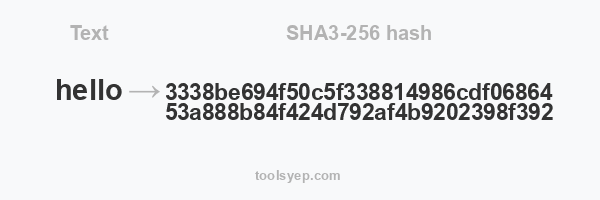
This online tool allows you to generate the hash sha3-256 of any string.
SHA3-256 length is 64 characters
Hash available
MD2 Hash, MD4 Hash, MD5 Hash, SHA1 Hash, SHA224 Hash, SHA256 Hash, SHA384 Hash, SHA512/224 Hash, SHA512/256 Hash, SHA512 Hash, SHA3-224 Hash, SHA3-256 Hash, SHA3-384 Hash, SHA3-512 Hash, RIPEMD128 Hash, RIPEMD160 Hash, RIPEMD256 Hash, RIPEMD320 Hash, WHIRLPOOL Hash, TIGER128,3 Hash, TIGER160,3 Hash, TIGER192,3 Hash, TIGER128,4 Hash, TIGER160,4 Hash, TIGER192,4 Hash, SNEFRU Hash, SNEFRU256 Hash, GOST Hash, GOST-CRYPTO Hash, ADLER32 Hash, CRC32 Hash, CRC32B Hash, CRC32C Hash, FNV132 Hash, FNV1A32 Hash, FNV164 Hash, FNV1A64 Hash, JOAAT Hash, MURMUR3A Hash, MURMUR3C Hash, MURMUR3F Hash, XXH32 Hash, XXH64 Hash, XXH3 Hash, XXH128 Hash, HAVAL128,3 Hash, HAVAL160,3 Hash, HAVAL192,3 Hash, HAVAL224,3 Hash, HAVAL256,3 Hash, HAVAL128,4 Hash, HAVAL160,4 Hash, HAVAL192,4 Hash, HAVAL224,4 Hash, HAVAL256,4 Hash, HAVAL128,5 Hash, HAVAL160,5 Hash, HAVAL192,5 Hash, HAVAL224,5 Hash, HAVAL256,5 Hash,
What is SHA3-256?
SHA3-256 is a member of the SHA-3 cryptographic hash family, standardized by NIST. Like all SHA-3 variants, it is based on the Keccak algorithm and utilizes a "sponge construction" design. It produces a 256-bit hash digest and is intended to be a secure, long-term successor to the SHA-2 family, offering a fundamentally different cryptographic approach.
How does SHA3-256 hash work?
The sponge construction separates the hashing process into two specific stages:
- Absorbing Phase: The input data is broken into chunks and XORed into the internal state of the algorithm. This state is then repeatedly transformed using the Keccak-f[1600] permutation function, which mixes the bits thoroughly.
- Squeezing Phase: Once the entire message has been processed ("absorbed"), the algorithm "squeezes" the current state to output the final 256-bit digest.
Key Characteristics
- Resistance to Length-Extension Attacks: Unlike the Merkle–Damgård construction used in SHA-2 (SHA-256, SHA-512), the sponge construction of SHA3-256 is naturally immune to length-extension attacks. This eliminates a specific class of vulnerabilities without needing extra "wrapper" constructions like HMAC.
- Hardware Efficiency: SHA-3 is designed for high performance on specialized hardware (ASICs and FPGAs), making it an excellent choice for environments where dedicated security hardware is used.
- Modern Cryptographic Standards: SHA3-256 is considered a robust, state-of-the-art algorithm. It provides 128 bits of security against collision attacks, satisfying modern requirements for secure digital signatures and cryptographic systems.
Comparison: SHA3-256 vs. SHA-256
- Design Philosophy: SHA-256 is based on the traditional block-processing (Merkle–Damgård) design. SHA3-256 represents a paradigm shift toward sponge-based designs.
- Performance: On standard CPUs, SHA-256 is often faster because it has been highly optimized in hardware and software over many years. SHA3-256 may appear slower in software-only environments, but it offers better architectural security and is more efficient in specialized hardware.
- When to choose: If you are working in a modern system and want to diversify your cryptographic security, or if you need to be explicitly protected against length-extension attacks, SHA3-256 is an excellent choice. It is often used alongside SHA-256 to provide "cryptographic agility," ensuring your system remains secure even if one algorithm is someday compromised.
SHA3-256 stands as a core component of modern cryptographic security, balancing advanced design with rigorous protection.