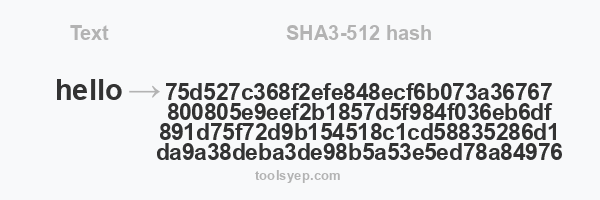
This online tool allows you to generate the hash sha3-512 of any string.
SHA3-512 length is 128 characters
Hash available
MD2 Hash, MD4 Hash, MD5 Hash, SHA1 Hash, SHA224 Hash, SHA256 Hash, SHA384 Hash, SHA512/224 Hash, SHA512/256 Hash, SHA512 Hash, SHA3-224 Hash, SHA3-256 Hash, SHA3-384 Hash, SHA3-512 Hash, RIPEMD128 Hash, RIPEMD160 Hash, RIPEMD256 Hash, RIPEMD320 Hash, WHIRLPOOL Hash, TIGER128,3 Hash, TIGER160,3 Hash, TIGER192,3 Hash, TIGER128,4 Hash, TIGER160,4 Hash, TIGER192,4 Hash, SNEFRU Hash, SNEFRU256 Hash, GOST Hash, GOST-CRYPTO Hash, ADLER32 Hash, CRC32 Hash, CRC32B Hash, CRC32C Hash, FNV132 Hash, FNV1A32 Hash, FNV164 Hash, FNV1A64 Hash, JOAAT Hash, MURMUR3A Hash, MURMUR3C Hash, MURMUR3F Hash, XXH32 Hash, XXH64 Hash, XXH3 Hash, XXH128 Hash, HAVAL128,3 Hash, HAVAL160,3 Hash, HAVAL192,3 Hash, HAVAL224,3 Hash, HAVAL256,3 Hash, HAVAL128,4 Hash, HAVAL160,4 Hash, HAVAL192,4 Hash, HAVAL224,4 Hash, HAVAL256,4 Hash, HAVAL128,5 Hash, HAVAL160,5 Hash, HAVAL192,5 Hash, HAVAL224,5 Hash, HAVAL256,5 Hash,
What is SHA3-512?
SHA3-512 is the highest-capacity member of the SHA-3 cryptographic hash family. Based on the Keccak algorithm, it utilizes the innovative "sponge construction" design to provide a 512-bit hash digest. It is the modern gold standard for high-security environments, designed to offer maximum collision resistance and architectural immunity to threats that historically affected older hash functions.
How does SHA3-512 hash work?
The sponge construction operates through two primary phases that ensure high diffusion and security:
- Absorbing Phase: The input message is padded and XORed into the internal state (the "rate" portion). The entire state is then transformed by the Keccak-f[1600] permutation function. This mixing process is repeated until every bit of the input is fully "absorbed" into the state.
- Squeezing Phase: Once the input is processed, the algorithm "squeezes" the internal state to produce the 512-bit output. The large size of the internal state relative to the output ensures a very high security margin.
Key Characteristics
- Maximum Security Margin: SHA3-512 provides 256 bits of security against collision attacks. It is currently one of the most robust cryptographic primitives available, making it ideal for high-stakes applications like long-term data archiving and root-of-trust systems.
- Immunity to Length-Extension Attacks: Unlike the SHA-2 family, the sponge construction is natively immune to length-extension attacks. This simplifies the design of secure protocols, as developers do not need to implement complex workarounds to keep the hash secure.
- Design Diversity: SHA3-512 provides a complete architectural break from the SHA-2 series. If a breakthrough were to occur in the analysis of Merkle–Damgård hashes, SHA3-512 would remain entirely secure due to its sponge-based design.
Comparison: SHA3-512 vs. SHA-512 (SHA-2 Family)
- Architectural Robustness: While SHA-512 (SHA-2) relies on the block-based Merkle–Damgård construction, SHA3-512 relies on the permutation-based sponge construction. SHA3-512 is considered more "future-proof" against structural cryptanalytic attacks.
- Performance: In typical software environments, the SHA-2 family (SHA-512) generally runs faster because it has been heavily optimized for standard CPU instruction sets over many years. SHA3-512 is often faster in environments with custom hardware (FPGAs/ASICs) that can perform the Keccak permutations in parallel.
- When to choose: If you are designing a system where you need the highest possible security assurance and are not solely optimizing for the absolute lowest latency on legacy hardware, SHA3-512 is the superior modern choice.
SHA3-512 represents the peak of modern cryptographic hashing, offering exceptional security and structural integrity.