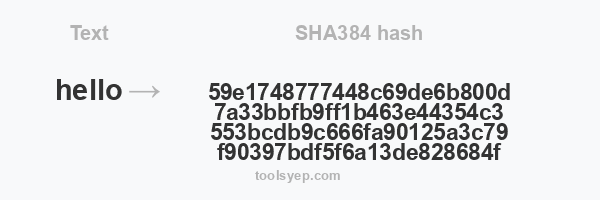
This online tool allows you to generate the hash sha384 of any string.
SHA384 length is 96 characters
Hash available
MD2 Hash, MD4 Hash, MD5 Hash, SHA1 Hash, SHA224 Hash, SHA256 Hash, SHA384 Hash, SHA512/224 Hash, SHA512/256 Hash, SHA512 Hash, SHA3-224 Hash, SHA3-256 Hash, SHA3-384 Hash, SHA3-512 Hash, RIPEMD128 Hash, RIPEMD160 Hash, RIPEMD256 Hash, RIPEMD320 Hash, WHIRLPOOL Hash, TIGER128,3 Hash, TIGER160,3 Hash, TIGER192,3 Hash, TIGER128,4 Hash, TIGER160,4 Hash, TIGER192,4 Hash, SNEFRU Hash, SNEFRU256 Hash, GOST Hash, GOST-CRYPTO Hash, ADLER32 Hash, CRC32 Hash, CRC32B Hash, CRC32C Hash, FNV132 Hash, FNV1A32 Hash, FNV164 Hash, FNV1A64 Hash, JOAAT Hash, MURMUR3A Hash, MURMUR3C Hash, MURMUR3F Hash, XXH32 Hash, XXH64 Hash, XXH3 Hash, XXH128 Hash, HAVAL128,3 Hash, HAVAL160,3 Hash, HAVAL192,3 Hash, HAVAL224,3 Hash, HAVAL256,3 Hash, HAVAL128,4 Hash, HAVAL160,4 Hash, HAVAL192,4 Hash, HAVAL224,4 Hash, HAVAL256,4 Hash, HAVAL128,5 Hash, HAVAL160,5 Hash, HAVAL192,5 Hash, HAVAL224,5 Hash, HAVAL256,5 Hash,
What is SHA-384?
SHA-384 (Secure Hash Algorithm 384-bit) is a cryptographic hash function that belongs to the SHA-2 family. It is a truncated version of the SHA-512 algorithm. By producing a 384-bit digest, it offers a high level of security while being specifically optimized for 64-bit architectures, making it a very efficient and secure choice for high-performance computing environments.
How does SHA-384 hash work?
SHA-384 follows the Merkle-Damgård construction and shares the same core logic as SHA-512:
- Initialization: It uses eight 64-bit working registers, initialized with unique constants that differ from those used in SHA-512 to prevent cross-algorithm attacks.
- Padding: The input message is padded to be a multiple of 1024 bits.
- Processing: The message is processed in 1024-bit blocks. Each block undergoes 80 rounds of logical operations (XOR, AND, OR, NOT), rotations, and additions.
- Truncation: After the final block is processed, the resulting 512-bit state is truncated by discarding the final 128 bits, resulting in the final 384-bit output.
Key Characteristics
- 64-bit Optimization: Because it uses 64-bit registers, SHA-384 is significantly faster than SHA-256 on modern 64-bit processors, despite producing a larger hash.
- Security Margin: It provides a 192-bit security level against collision attacks. This is well above the threshold required for most modern security standards, making it highly suitable for high-security applications like digital certificates and TLS.
- Resistance to Length-Extension Attacks: By using different initialization constants than SHA-512, SHA-384 is inherently resistant to length-extension attacks, which is a common vulnerability in older hash functions like MD5 or SHA-1.
- Efficiency: It is often preferred in environments where SHA-512 is considered "too long" for a specific protocol, but where the superior speed of 64-bit processing is required over the 32-bit-optimized SHA-224 or SHA-256.